
网上一搜一大把,搜出来的结果几乎都是我很崇敬的张孝祥老师写的这道题的思路,甚至有的直接把原文copy paste过来,没有一个用代码实现了的。于是自己琢磨了下,这里发布出来。虽然标题是一百亿,但实现结果可用于任意大整数。
直接上代码。这里只实现了大整数相加。有了这个,不难实现减、乘等其他操作。代码复制粘帖即可运行。
MyBigInteger.java
import java.util.ArrayList;import java.util.regex.Matcher;import java.util.regex.Pattern;/** * Created by Rocky on 14-3-26. */public class MyBigInteger { private char sign = '0'; // 0 表示正数 - 表示负数 private byte[] data; public MyBigInteger() { this.data = "0".getBytes(); } public MyBigInteger(String value) throws Exception { //正则表达式,输入字符串要求以 零个或一个 - 开头,其余都是数字 Pattern pattern = Pattern.compile("^-?\d+$"); if (value == null || value.length() <= 0) { value = "0"; } Matcher matcher = pattern.matcher(value); if (!matcher.find()) { throw new Exception("the value is not a number string :" + value); } //获取字符串的第一个字符 char firstChar = value.charAt(0); //data应该保存的是第一个非0数字后的字符串 if (firstChar == '-') { //说明输入的是个负数 if (value.length() >=2) { sign = firstChar; value = value.substring(1); value = getTemp(value); //得到value中第一个非0后的子字符串。 } } else { value = getTemp(value); } this.data = value.getBytes(); } /** * 得到一个字符串第一个非0后的字符串,如果没有找到,则返回 "0" 。如:00003435534,则返回3435534 * @return */ private String getTemp(String value){ Pattern pattern = Pattern.compile("[^0]{1}"); Matcher matcher = pattern.matcher(value); if (matcher.find()) { value = value.substring(matcher.start()); } else { value = "0"; } return value; } public MyBigInteger add(MyBigInteger other) { MyBigInteger result = new MyBigInteger(); int thisLength = this.data.length; int otherLength = other.data.length; int shorterLength = thisLength > otherLength ? otherLength : thisLength; ArrayList<Byte> resultData = new ArrayList<Byte>(); int flag = 0; //表示相加时的 进位,或相减时的 借位 int i = thisLength - 1; int j = otherLength - 1; int k = shorterLength; //两个数的符号相同 if (other.sign == this.sign) { //从两个整数的个位开始依次相加 while (k > 0) { Integer temp = new Integer(new String(new byte[]{this.data[i]})) + new Integer(new String(new byte[]{other.data[j]})) + flag; flag = temp / 10; //相加结果超过10时的进位。没有超过10,进位为 0 resultData.add(0, ((temp % 10) + "").getBytes()[0]); //把相加结果保存起来 k--; i--; j--; } //把多出的位加入到结果中 if (i == -1) { while (j >= 0) { Integer temp = new Integer(new String(new byte[]{other.data[j]})) + flag; flag = temp / 10; resultData.add(0, ((temp % 10) + "").getBytes()[0]); j--; } } else if (j == -1) { while (i >= 0) { Integer temp = new Integer(new String(new byte[]{this.data[i]})) + flag; flag = temp / 10; resultData.add(0, ((temp % 10) + "").getBytes()[0]); i--; } } //最后把flag加进结果中 if (flag != 0) { for (byte by : (flag + "").getBytes()) { resultData.add(0, by); } } result.sign = other.sign; } else { //符号不同 if (thisLength > otherLength) { //说明this表示的整数绝对值大,所以最终结果的符号为this的符号 result.sign = this.sign; resultData = subtract(this.data, other.data); //执行减法 } else if (thisLength < otherLength) { //other表示的整数绝对值大,所以最终结果的符号为other的符号 result.sign = other.sign; resultData = subtract(other.data, this.data); } else { //如果两个数据的位数相同 Integer thisInt = 0; Integer otherInt = 0; //从第一位开始比较,直到两者不相等 for (int n = 0; n < thisLength; n++) { thisInt = new Integer(new String(new byte[]{this.data[n]})); otherInt = new Integer(new String(new byte[]{other.data[n]})); if (!thisInt.equals(otherInt)) { //注意这里要使用equals方法,因为这里需要比较的是两者的内容 break; } } //如果this的绝对值大 if (thisInt > otherInt) { result.sign = this.sign; resultData = subtract(this.data, other.data); } else { result.sign = other.sign; resultData = subtract(other.data, this.data); } } } result.data = new byte[resultData.size()]; for (int m = 0; m < resultData.size(); m++) { result.data[m] = resultData.get(m); } return result; } private ArrayList<Byte> subtract(byte[] larger, byte[] smaller) { ArrayList<Byte> resultData = new ArrayList<Byte>(); int flag = 0; int i = smaller.length - 1; int j = larger.length - 1; int k = smaller.length; while (k > 0) { Integer temp = new Integer(new String(new byte[]{larger[j]})) + flag - new Integer(new String(new byte[]{smaller[i]})); if (temp < 0) { //如果相减结果小于0,说明需要借位,则把flag置为 -1,以便下一位减去 flag = -1; temp += 10; } else { //如果大于零,需要把flag置为 0.不要忘记了 flag = 0; } resultData.add(0, (temp + "").getBytes()[0]); j--; i--; k--; } //下面的代码就不写注释了 while (j >= 0) { Integer temp = new Integer(new String(new byte[]{larger[j]})) + flag; if (temp < 0) { flag = -1; temp += 10; } else { flag = 0; } resultData.add(0, (temp + "").getBytes()[0]); j--; } return resultData; } @Override public String toString() { String str = new String(this.data); str = getTemp(str); if (sign == '-' && str !="0") { str = sign + str; } return str; }}MyBigIntegerTest.java
import junit. work.TestCase;import java.math.BigInteger;/** * Created by Rocky on 14-3-26. */public class MyBigIntegerTest extends TestCase { public void test1() throws Exception { String a1 = "-5453450543044355356576980545345054545453453454344435353254545345054304435535657698087756454543454345454534534543444353532545453450543044355356454543454354353450136546534534545345345054353450136546534534545345345043044355356576980657698087756454543454354353450136546534534545345345054353450136546534534545345345043044355356576980877564545434543543534501877564545434543543534501"; String b1 = "4545453453454344435353254545345054304435535657698087756454543454354345454534534543444353532545453450543044355356576980877564545434545454534534564545434543543534501365465345345453453450543534501365465345345453453450430443553565769804344435353254545345054304435535657698087756454543454354353450136546534534545345345043543534501365465345345453453450534501365465345345453453450"; MyBigInteger a = new MyBigInteger(a1); MyBigInteger b = new MyBigInteger(b1); MyBigInteger c = a.add(b); System.out.println(c); BigInteger a2 = new BigInteger(a1); BigInteger b2 = new BigInteger(b1); BigInteger c2 = a2.add(b2); System.out.println(c2); System.out.println(c2.toString().equals(c.toString())); }}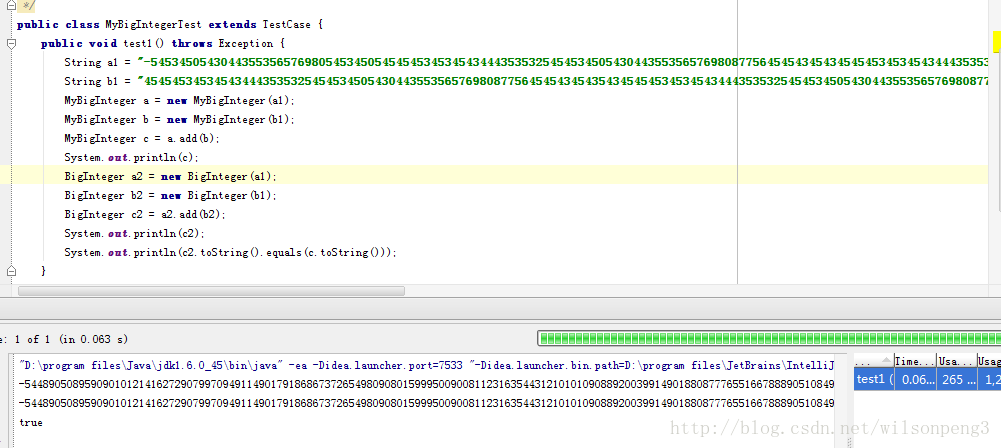
继续阅读与本文标签相同的文章
-
Remove SVN From Intellij IDEA
2026-06-02栏目: 教程
-
Mongodb学习文章辑录
2026-06-02栏目: 教程
-
Open-source Project官方地址
2026-06-02栏目: 教程
-
迷宫算法实现
2026-06-02栏目: 教程
-
A算法详解
2026-06-02栏目: 教程