
题注
《面试宝典》有相关习题,但思路相对不清晰,排版有错误,作者对此参考相关书籍和自己观点进行了重写,供大家参考。
最小生成树——包含带权图中的全部顶点并不能形成环,且权值之和最小的图。
求解最小生成树的方法包括:Prim算法和Kruskal算法。
对于Prim算法思想:1)从源结点集中选定一个源结点(初始源节点集合中只有设定一个结点);2)从剩余结点中选择与源节点集有连接的且权值最小的边。将该源节点加入源节点集合中。然后迭代执行1),2)。
如下图的图结构,含有7个顶点,下图示为图的邻接矩阵存储结构。
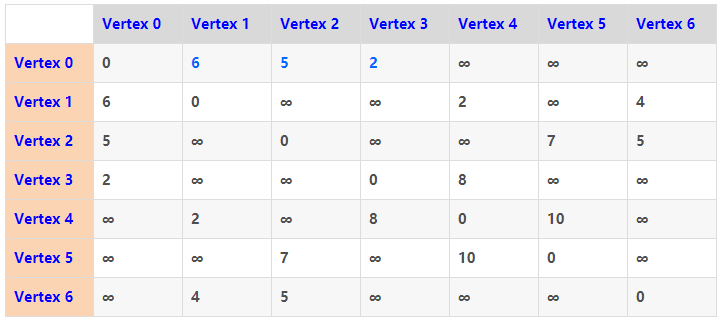
模拟执行步骤如下:
前提:源节点集合VertexSet中初始只有设定的0(假定,可以任意取0à6中任意值)。起初初始的边结合EdgeSet为空。
步骤 1:从与0相连的边集合中,选定权值最小的边,对应上图Vertex0行显然为2。所以选择的顶点为Vertex3。
| VertexSet | EdgeSet | SumWeight |
|---|---|---|
| 0,3 | (0,3) | 2 |
步骤 2:从与{0,3}相连的边集合中,选定权值最小的边,如下图,显然权值为5。所以选择的顶点为Vertex2。
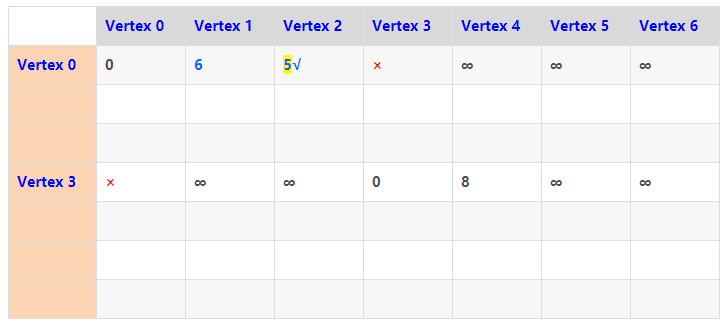
集合变为:
| VertexSet | EdgeSet | SumWeight |
|---|---|---|
| 0,3,2 | (0,3)(0,2) | 2+5 |
步骤 3:从与{0,3,2}相连的边集合中,选定权值最小的边,如下图,显然权值为4。所以选择的顶点为Vertex6。
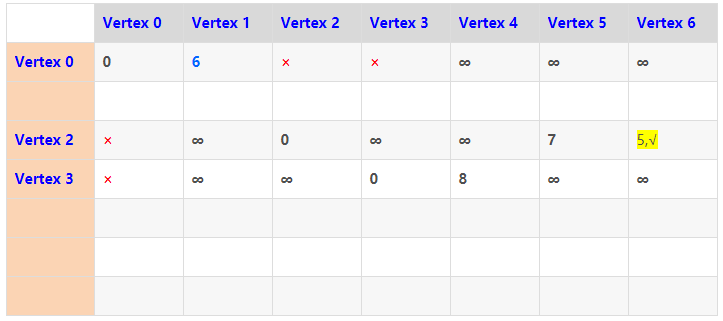
集合变为:
| VertexSet | EdgeSet | SumWeight |
|---|---|---|
| 0,3,2,6 | (0,3)(0,2)(2,6) | 2+5+5 |
步骤4:从与{0,3,2,6}相连的边集合中,选定权值最小的边,如下图,显然权值为5。所以选择的顶点为Vertex1。
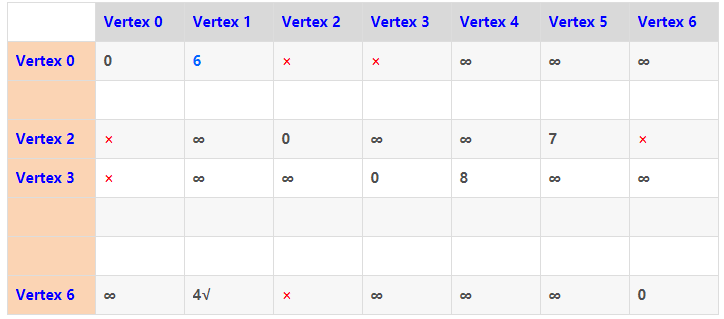
集合变为:
| VertexSet | EdgeSet | SumWeight |
|---|---|---|
| 0,3,2,6,1 | (0,3)(0,2)(2,6)(6,1) | 2+5+5+4 |
步骤5:从与{0,3,2,6,1}相连的边集合中,选定权值最小的边,如下图,显然权值为2。所以选择的顶点为Vertex4。
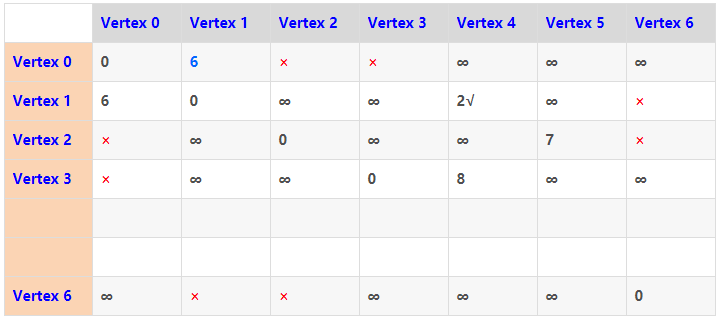
集合变为:
| VertexSet | EdgeSet | SumWeight |
|---|---|---|
| 0,3,2,6,1,4 | (0,3)(0,2)(2,6)(6,1)(1,4) | 2+5+5+4+2 |
步骤6:从与{0,3,2,6,1,4}相连的边集合中,选定权值最小的边,如下图,显然权值为2。所以选择的顶点为Vertex4。
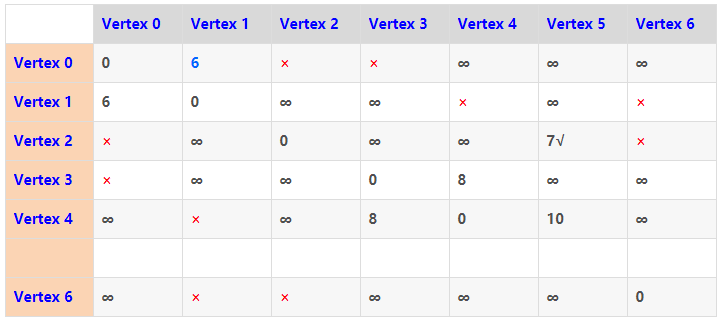
集合变为:
| VertexSet | EdgeSet | SumWeight |
|---|---|---|
| 0,3,2,6,1,4,5 | 0,3,2,6,1,4,5 | 2+5+5+4+2+7 |
最后:遍历后的结果如下2图:即包含所有顶点,没有环路,且权值最小。
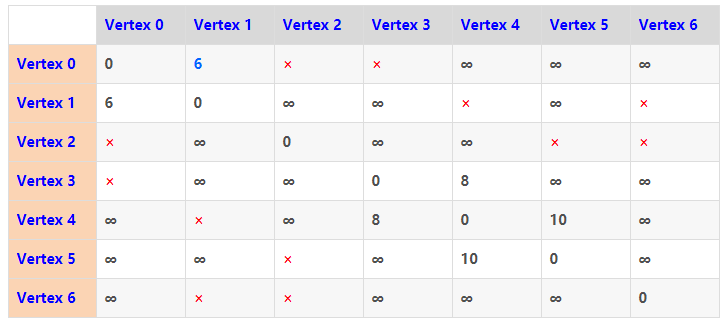
| VertexSet | EdgeSet | SumWeight |
|---|---|---|
| 0,3,2,6,1,4,5 | (0,3)(0,2)(2,6)(6,1)(1,4)(2,5) | 2+5+5+4+2+7=25 |
//inifinity 代表权值无穷大,即不可达。int g_WeightMatrix[7][7] ={0,6,5,2,infinity,infinity,infinity, 6,0,infinity,infinity,2,infinity,4, 5,infinity,0,infinity,infinity,7,5, 2,infinity,infinity,0,8,infinity,infinity, infinity,2,infinity,8,0,10,infinity, infinity,infinity,7,infinity,10,0,infinity, infinity,4,5,infinity,infinity,infinity,0}; template<class vType, int size>class msTreeType : publicgraphType<vType, size>{public: voidcreateSpanningGraph(); voidminimalSpanning(vType sVertex); voidprintTreeAndWeight();protected: vTypesource; // intweights[size][size]; //权重数组 intedges[size]; //边的集合,edges[0]=5即代表0-5之间有边存在。 intedgeWeights[size]; //存储从某顶点开始的权重.};1.创建权重图
创建权重图的时候,我们做了简化处理。只是将给定的权重数组赋值过来了。[此处稍作修改,便可以改为手动输入顶点及邻接边的关系]。图的存储形式:邻接矩阵存储!
template <class vType, int size>voidmsTreeType<vType,size>::createSpanningGraph(){ gSize= size; source= 0; //记录初始点为0. for(int i = 0; i < size; i++) { for(int j =0; j < size; j++) { weights[i][j]= g_WeightMatrix[i][j]; if(weights[i][j]!= 0 && weights[i][j] != infinity) { edges[i]= j; //代表i--j之间的连线存在 // cout << "edges[ " <<i << " ]=" << edges[i] << " "; } cout<< weights[i][j] << " "; } cout<< endl; }}2.最小生成树
1.巧妙的记录源结点、目标结点的方法(通过数组下标和结果值);2.还需要存储每次比较后的最小的权重值。
template <class vType, int size>voidmsTreeType<vType,size>::minimalSpanning(vType sVertex){ vType startVertex, endVertex; int minWeight; source = sVertex; //代表mstree的结点结合中是否存在点. mstv[5] =true,代表结点5在集合中已经存在。//=false,则代表不存在. bool mstv[size]; //初始化 0代表到自身, infinity代表不可达. for(int j = 0; j < gSize; j++) { mstv[j]= false; edges[j]= source; edgeWeights[j]= weights[source][j]; } mstv[source]= true; edgeWeights[source]= 0; //初始设定 for(int i = 0; i < gSize-1; i++) { minWeight= infinity; //从所有顶点中寻找权重最小且未被标识的顶点,v记录该顶点,minWeight记录权重值。 for(int j = 0; j < gSize; j++) { if(mstv[j])//mstv中已经存在的点j { for(intk=0; k < gSize; k++) { //寻找由已经存在的结点中到剩余结点权值最小的边。 if(!mstv[k]&& weights[j][k] < minWeight) { endVertex= k; //目的 startVertex= j; //源 minWeight= weights[j][k]; //最小权重 } }//endfor k }//endif(mstv[j]) }//endfor j mstv[endVertex]= true; edges[endVertex]= startVertex; edgeWeights[endVertex]= minWeight; }//endfor}3.打印小生成树
template <class vType, int size>voidmsTreeType<vType,size>::printTreeAndWeight(){ inttreeWeight = 0; minimalSpanning(source); cout<< "Source vertex: " << source << endl; cout<< "Edges Weight" << endl; for(int j = 0; j < gSize; j++) { if(edgeWeights[j]!= 0) { treeWeight= treeWeight + edgeWeights[j]; cout<< "(" << j << ", " <<edges[j] << ") "<< edgeWeights[j] << endl; } } cout<< endl; cout<< "Tree Weight: " << treeWeight << endl;}作者:铭毅天下
来源:CSDN
原文:https://blog.csdn.net/laoyang360/article/details/7905688
版权声明:本文为博主原创文章,转载请附上博文链接!
继续阅读与本文标签相同的文章
-
企业级业务架构的设计难点
2026-05-18栏目: 教程
-
玩数据必备Python库:Numpy使用详解
2026-05-18栏目: 教程
-
商业银行业务架构设计
2026-05-18栏目: 教程
-
企业级业务架构设计方法与“中台”概念的比较
2026-05-18栏目: 教程
-
为什么Flink会成为下一代大数据处理框架的标准?
2026-05-18栏目: 教程